Mikumi Day Safari Itinerary: Hour by Hour
What actually happens, hour by hour, on a direct fly-in Mikumi day safari from Zanzibar — from pre-dawn pickup to evening drop-off, with realistic timings and what can go wrong at each stage.
There is no single official timetable for this trip. Clock times shift with your operator, your flight schedule, the season, and which part of Zanzibar you are staying in. What follows is a realistic composite, built from a wide range of actual operator itineraries, so you know roughly what to expect rather than a single fixed schedule to hold anyone to.
Check Availability
This covers the direct fly-in route, landing at the airstrip inside Mikumi itself — not the longer routing via Dar es Salaam. If you are not sure which one you have booked, read fly-in vs via Dar es Salaam first, because the two are different days at nearly the same price.
The two fixed points the day is built around
Almost everything on a Mikumi day safari flexes. Two things do not: a morning flight out of Zanzibar at around 7am, and a return flight out of Mikumi in the mid-afternoon. Pickup time, lunch style and the exact length of each game drive all arrange themselves around those two anchors.
That matters more than it sounds. Because the return flight is fixed, every delay earlier in the day comes out of your game-drive time rather than pushing the end of the day back — and because the morning flight is fixed, your pickup time is set by how far your hotel is from the airport, not by when you would like to leave. Read the rest of this itinerary with those two pins in mind and the shape of the day makes sense.
The most-booked fly-in day safari from Zanzibar — 4.7 out of 5 across more than 3,000 verified reviews, from $430 with flights, park fees and lunch included — runs exactly this shape, and it is the trip the timings below are drawn around.
What the day adds up to
Before the stage-by-stage detail, here is the whole thing in numbers. A fly-in Mikumi day trip typically breaks down as:
- Door-to-door: roughly 12–14 hours
- Flight time (both legs combined): roughly 1.5–2 hours
- Actual game-drive time: roughly 5.5–7 hours
- Lunch and breaks: roughly an hour to an hour and a half
- Transfers and airport waiting: the biggest hidden chunk of the day — roughly 3.5–5 hours combined across both ends
That last figure is worth sitting with. Nearly a third of the day is spent getting to and from the wildlife rather than looking at it. It is still a real, worthwhile safari day — it is just not the eight-to-ten-hour figure some listings lead with, once you count the whole thing door to door. Whether that trade is the right one for you is a separate question, and we answer it honestly in is a Mikumi day safari worth it?
Before dawn: hotel pickup (roughly 4:00–5:45am)
A private car or minivan collects you from your hotel and drives you to Zanzibar’s airport. How early depends almost entirely on where you are staying.
If you are in Stone Town or somewhere close to the airport, expect a pickup around 5:00–5:45am. If you are in the far north — Nungwi or Kendwa — expect something closer to 4:00–4:30am, since the transfer itself takes over an hour. The same logic applies to the further east-coast resorts.
Be ready in the lobby a few minutes early. Bring only a small daypack — leave your main luggage at the hotel, since it is not needed and light aircraft have tight weight limits. Ask your hotel the night before about an early breakfast box, since you will not be eating again for hours.
Airport check-in (roughly 6:00–6:45am)
You will be directed to a meeting point at the domestic terminal, usually around an hour before your flight. The process is straightforward but can feel a little disorganised at times — plenty of people, a small waiting area, a snack stall, and eventually a short walk through security and out to the aircraft.
Luggage limits are real and enforced. Light aircraft on this route typically allow around 15kg per person including hand luggage, and soft-sided bags are strongly preferred over hard suitcases. Keep your passport or ID and booking confirmation somewhere accessible — you will need them here.
The flight (roughly 7:00–8:15am)
The aircraft is small — typically a light single- or twin-engine plane seating a dozen or so passengers — and the flight itself is one of the better parts of the day. Expect scenic views across the Indian Ocean and the mainland coastline as you approach. It can be warm on the ground before takeoff, since the air conditioning needs the engines running to work properly; if you run warm, a small fan in your bag is a nice touch.
Flight time is short, usually somewhere between 40 minutes and just over an hour, landing you at the airstrip inside the park.
If the aircraft matters to you, it is worth booking for it deliberately rather than hoping: the twin-engine departure caps the group and flies a two-engine aircraft for $525, and rates 4.7 out of 5 across 147 reviews. We break the option down on its own tour page.
Arrival at the airstrip (roughly 8:00–8:15am)
This is not an airport in any conventional sense — it is a single dirt runway inside the park, with your guide and an open-roofed 4x4 waiting right beside it. There is no terminal building, though basic toilets are usually available at the landing point (worth carrying your own tissue and hand sanitiser, just in case).
The game drive begins essentially the moment you step off the plane. Your guide gives a short safety briefing, groups are split into vehicles, and you are moving within minutes — on a day that runs smoothly, at least. Occasionally there is a short delay here if a vehicle has not been properly allocated to the number of arriving guests. It is not the norm, but it happens often enough to be worth knowing about.
Morning game drive (roughly 8:15am–12:30/1:00pm)
This is the best part of the day for wildlife, and it is when most of the strongest sightings happen — animals are more active before the heat sets in, and this is genuinely your best window for lions if you are hoping to see them.
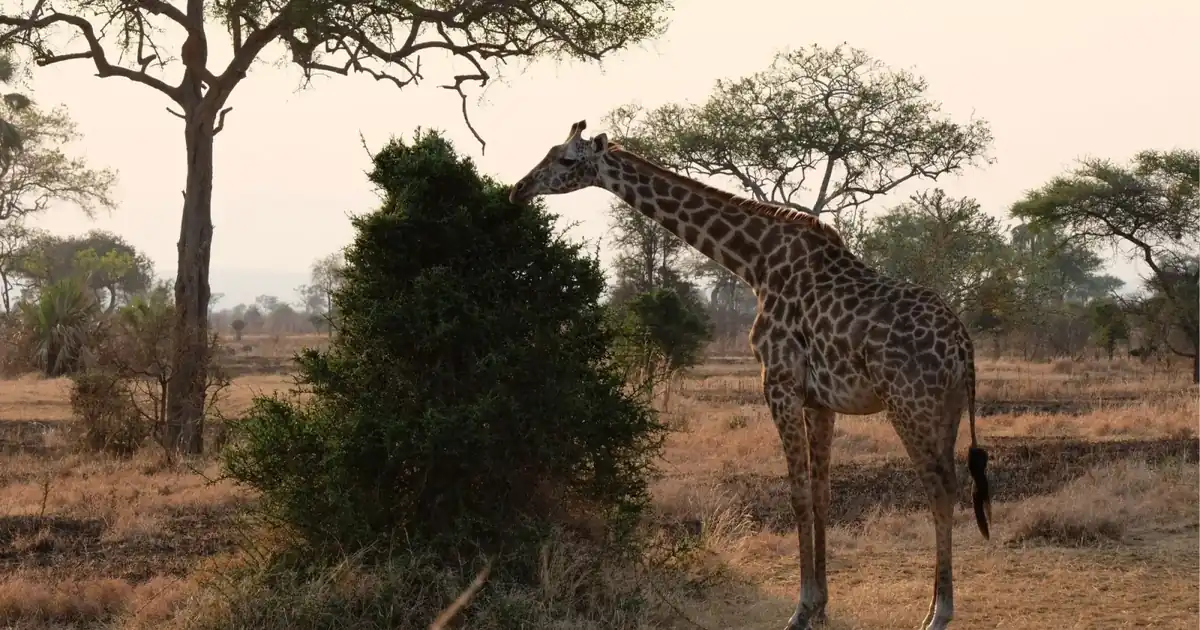
The drive covers the open Mkata Floodplain, the park’s main game-viewing area. Expect elephants, giraffes, zebra, buffalo, wildebeest and impala with high consistency, plus a real chance at lion. Our guide to what you will actually see separates the near-certainties from the ones that need luck.
It is colder than you would expect for a morning in equatorial Africa — the wind through an open-sided vehicle at speed is genuinely chilly, and it is dusty. Bring a light jacket or hoodie even though you will want to leave it in your bag for most of the day.
Lunch (roughly 12:30–1:30pm)
Lunch is either a bush picnic — often near the park’s Hippo Pools, a reliable spot for hippos, crocodiles and birdlife — or a hot, restaurant-style meal, depending on which operator and tier of product you have booked. It is worth confirming which one you are getting when you book, particularly if dietary needs matter to you.
Expect a toilet stop around now too. Basic facilities, so come prepared.
Afternoon game drive (roughly 1:30–3:30pm)
The afternoon covers different terrain — woodland, waterholes, baobab country — and turns up a different mix of sightings: kudu, warthog, more elephants and giraffes, and often crocodiles at the water’s edge.
This drive runs noticeably shorter than the morning one, and there is a reason for that: the return flight is fixed, and your guide has to work backward from it. If something exceptional turns up late in the afternoon, there is genuinely no flexibility to linger the way there might be on an overnight safari.
Return to the airstrip and flight back (roughly 3:30–5:15pm)
Vehicles head back to the airstrip in time for the return flight, which typically departs somewhere between 3pm and 4:30pm depending on the operator, landing back in Zanzibar around an hour later.
Evening: hotel drop-off (roughly 5:00–7:30pm)
A transfer takes you back to your hotel, with the same location-dependent timing as the morning — Stone Town guests are back earliest, northern and far east-coast guests later. On a day that runs to schedule, expect to be home somewhere between 5pm and 7:30pm, tired, a little dusty, and generally glad you did it.
This is the point to tip your guide and driver in cash, if you are planning to — it is not included in the tour price, and neither are the other extras our cost breakdown works through.
Where the day can go wrong
The airport and flight stage is the single most common failure point. Weather and aircraft availability both cause delays, and because everything downstream depends on this flight, a delay here compresses the whole day rather than just shifting it. In a genuinely bad case, a cancelled flight can cost the better part of a day, with no guarantee of compensation.
Vehicle allocation at the airstrip occasionally causes a short delay if the numbers do not quite match up on arrival — usually resolved within half an hour or so, but worth knowing is not unheard of.
Ticketing mix-ups on the return leg happen occasionally, particularly with last-minute schedule changes from the airline side.
None of this is common enough to expect it on your specific day, but it is common enough across the pattern of traveller experience that building in a buffer is genuinely sensible advice rather than overcaution. Do not schedule this trip within a day or two of flying home internationally, and check that your booking carries free cancellation up to 24 hours before departure — every listing on this site does. Our guide to what free cancellation covers, and what it does not, when weather grounds the flight sets it out.
Packing for the day, stage by stage
- Documents: passport or ID, booking confirmation
- Bag: one small soft daypack only, under the weight limit — leave everything else at the hotel
- Clothing: a light jacket or hoodie for the chilly, dusty morning drive; a hat; sunglasses; closed shoes
- Sun protection: sunscreen, reapplied through the day
- Basics: tissues and hand sanitiser for the basic toilet facilities
- For the wildlife: camera, binoculars if you have them, spare battery or power bank
- Cash: for tips at the end of the day, and any snacks or drinks after airport security
Our full packing guide covers the same ground in more detail, including malaria precautions.
Frequently asked questions
What time does pickup actually start? Anywhere from about 4am to 5:45am, depending on your hotel’s distance from the airport. Confirm your specific time with the operator the night before.
How much of the day is actually spent looking at wildlife? Realistically 5.5 to 7 hours out of a 12–14 hour day. The rest is transfers, flights and lunch.
What happens if the morning flight is delayed? It eats directly into your game-drive time, since the return flight stays fixed. In the worst cases, a cancellation can cost most of the day. This is the single biggest risk on this trip.
Is the afternoon drive as good as the morning one? Generally shorter and slightly less active, since animals are less mobile in the afternoon heat and the guide is working backward from a fixed return flight.
Should I book the earliest available flight? Yes, if you have the choice — it maximises your chance of seeing predators and gives you the most buffer if something runs late.
Ready to hold a date? Every safari we list books with free cancellation up to 24 hours before departure — compare them all.
See Tanzania's Big Game — and Sleep on Zanzibar Tonight
Join 3,000+ travellers who have flown Zanzibar–Mikumi and back in a day. Return flights, park entry and landing fees, a shared 4x4 game drive and a bush lunch are all included. Free cancellation up to 24 hours before.
Check Availability & Book